

Ever stopped mid-sentence because you weren’t sure how to spell a word? You’re not alone. The Lieing or Lying question pops up in school essays, work emails, and social posts all the time.
Here’s the short answer: the correct spelling is lying. Lieing isn’t a real English word, so you won’t find it in any dictionary. Lying comes from the verb lie, and English drops the silent e before adding -ing. Let’s break down the rule, the two meanings, and a few easy tricks that stick.
Why the Spelling Trips People Up
Most people don’t mess this up on purpose. The word just looks like it should be spelled with an “ie.”
Think about words like believe, field, and piece. They keep the “ie,” so your brain expects the same pattern here.
English, though, plays by its own rules. When a word ends in a silent e and you add -ing, the e usually disappears.
Take make becoming making, or write becoming writing. Lie follows that same path.
The Simple Rule Behind Lying
Here’s the rule in plain talk. Drop the e, then add -ing.
Lie becomes lying. Die becomes dying. Tie becomes tying.
Notice that die, tie, and lie end in “ie.” English spells their -ing forms with a “y” to avoid the clumsy “ie” plus “ing” combo.
So if you’re ever unsure, remember this pattern. Once you see it with one verb, you’ll spot it everywhere.
Lie or Lying Meaning: Two Different Meanings
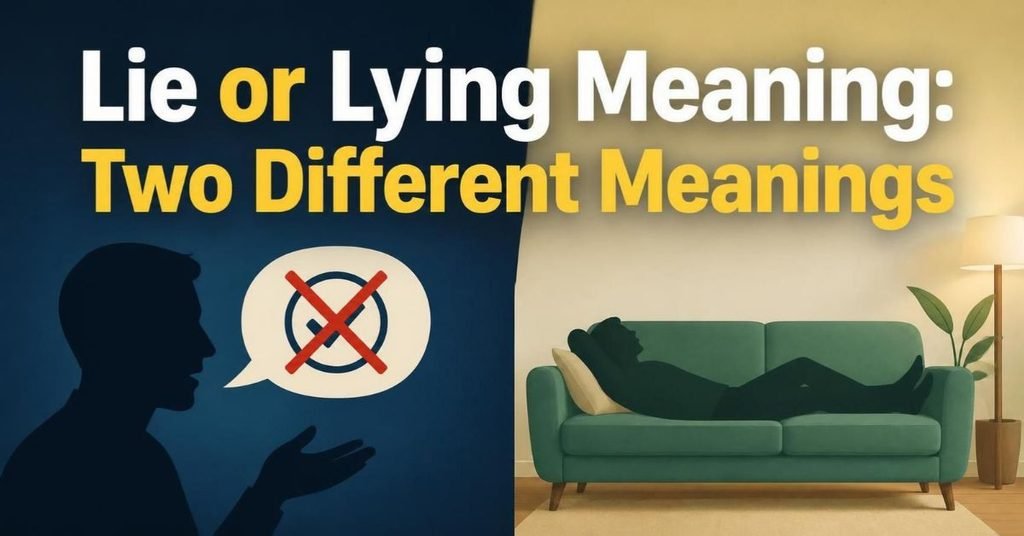
Here’s where it gets interesting. The verb lie has two separate meanings, and each one has its own forms.
The first meaning is to rest or recline. You might be lying down after a long day, or lying in bed with a book.
The second meaning is to tell an untruth. Someone who says something false is telling an untruth, or simply lying.
Both meanings use the same spelling, so context does all the work. Ask yourself whether the sentence is about a body in a flat position or about honesty.
Lieing vs Lying Difference Explained
The real difference is simple. Lieing is a misspelling, and lying is the correct form.
Many people assume there’s a second version with a different meaning. There isn’t.
Only one correct spelling exists, and it works for both meanings above.
Lying Down, Laying, and the Lie vs Lay Mix Up
This is the mistake that causes the most confusion. Lie and lay sound alike, but they don’t mean the same thing.
Lie is usually intransitive. It doesn’t take a direct object. You lie down on the bed, but you don’t lie a book on the table.
Lay is transitive. It needs a direct object, meaning something gets placed. You lay a book on the table or lay the baby in the crib.
Here’s a quick way to check yourself:
- Use lie or lying when a person or animal rests in a horizontal position, like lying on the couch.
- Use lay or laying when you place something down, like laying the keys on the counter.
- Use lying for telling an untruth, like lying to a friend.
A handy test: if you can replace the word with “rest,” you probably need lie. If you can replace it with “put,” you probably need lay.
Past Tense and Past Participle of Lie
Verb forms are where many writers get stuck. Here’s the full set.
For the verb lie meaning to rest, the forms are lie, lay, lain, lying. The past tense is lay, and the past participle is lain.
For the verb meaning to tell an untruth, the forms are lie, lied, lied, lying. Here the past tense and past participle are both lied.
So “I lay down yesterday” is correct. “I have lain down before” is correct too. “He lied to me” is correct as well.
| Also Read This : |
| You To or You Too: Meaning, Rules & Examples 2026 |
| Speach or Speech: Correct Spelling, Meaning & Uses 2026 |
| Burry vs Bury: Common Mistakes You Should Know 2026 |
Dying, Tying, and Vying: Same Rule, Different Verbs
Once you understand lying, the same pattern covers a few other common words. Writers often mix these up in the same way.
Dying comes from die, and it’s not dieing. Tying comes from tie, and it’s not tieing. Vying comes from vie, which means to compete, and it’s not vieing.
The lesson here is that the -ie to -y change is the rule, not a one-off exception. If you remember it once, you’ll avoid these errors for good.
Lying in Everyday Writing and Professional Emails
Spelling matters most when people read your words. A small slip can make you look careless, especially in work messages.
In a professional email, you might write, “I’m not lying about the deadline. The report is ready.” Clear and correct, and no one doubts your credibility.
In a school essay, you could write, “The character keeps lying to his family.” Simple words, correct spelling, and a clear point.
In a social media post, you might say, “She’s lying on the beach and ignoring her inbox.” Short, fun, and error free.
Lying in British and American English
Some readers wonder whether spelling changes between regions. Here’s the good news.
Lying is the same in British English, American English, and Australian English. These versions differ on words like “colour” and “color,” but the verb forms here stay the same.
That means you can use lying with confidence wherever you write. Your readers in London, New York, or Sydney will all read it the same way.
Quick Tips to Spell Lying Right Every Time
Want an easy way to lock this in? Try these simple habits.
- Say the verb first. Think lie, then drop the e and add -ing.
- Compare it to die and tie. If you spell dying and tying correctly, lying follows the same path.
- Use a spell checker. Tools like Microsoft Word, Google Docs, and Grammarly flag lieing right away.
- Test the meaning. Ask whether the sentence means resting or telling an untruth, then pick your verb.
- Read your sentence aloud. If “laying” sounds wrong for a person resting, switch to lying.
These habits take seconds but save you from embarrassing errors.
Common Mistakes to Avoid
Even careful writers slip up with this word. Watch out for these traps.
The first trap is typing lieing out of habit. Your fingers may follow the old “ie” pattern, so slow down and check.
The second trap is mixing up lie and lay. Remember that lay needs an object, while lie does not.
The third trap is using dieing or tieing. Both are wrong, and the correct forms are dying and tying.
The fourth trap is trusting a spell checker without thinking. Automatic tools help, but they can miss a wrong word used in the wrong sense.
Why Getting It Right Matters
You might wonder if a single letter really matters. In most cases, readers will understand you anyway.
But small errors add up. Your spelling affects how trustworthy you seem, especially in job applications, academic work, and professional emails.
Think about a resume that says you have lieing about qualifications. Yikes. That one mistake can make a hiring manager doubt the rest of your application.
Getting the word right shows care. It tells your reader you took the time to check your work.
Frequently Asked Questions
Is Lieing or Lying spelled correctly?
The correct spelling is lying. Lieing is a common mistake, so you should avoid it in every kind of writing.
Why is it lying and not lieing?
English drops the silent e before adding -ing. Lie becomes lying, just like die becomes dying in the same way.
What is the difference between lying and lieing?
Lieing is a misspelling. Lying is correct and means resting or telling an untruth. Context decides which one fits.
What is the past tense of lie?
The past tense is lay when you recline. When you tell an untruth, the past tense is lied. Read on for examples.
Is lying correct in British English?
Yes, lying is correct in British and American English alike. The spelling never changes between the two versions. Good news.
What is the difference between lying and laying?
Lying means resting or telling an untruth. Laying means placing something down, like laying a book on a table. Use it today.
Why is dieing wrong?
Dieing is wrong because English changes ie to y before -ing. The correct form is dying, the same rule as lying.
Is lieing a real word?
No, lieing is not a real word in any dictionary. It is a misspelling of lying, so avoid it in writing.
Conclusion
Lieing or Lying is a question that keeps coming back, and now you have the answer. The correct spelling is lying. Lieing is simply a mistake that happens because the word looks like it should follow the “ie” pattern.
Here’s what to remember. Drop the silent e from lie, then add -ing. Lying can mean resting flat or telling an untruth, so let the sentence guide you. For laying something down, use laying instead.
Next time you wonder about Lieing or Lying, you’ll know the right choice. Share this guide with a friend who keeps mixing them up. Or drop a comment below with a sentence you’re unsure about, and let’s check it together.

Jack Thompson is the admin of ModernHexa.com, a platform focused on grammar, language, and effective communication. With a strong interest in English grammar and writing, Jack works to provide clear, practical, and easy-to-understand content that helps readers improve their language skills and communicate with greater confidence.
