
Have you ever typed foward in a message and wondered whether it was right? You’re not alone. This small spelling mistake is easy to make, especially when typing quickly or writing emails. However, only one spelling is standard English.
In the Foward vs Forward comparison, forward is the correct spelling. Foward is a common misspelling that leaves out the letter r after the first o. You’ll see forward in everyday messages, school assignments, business emails, and conversations about progress. Knowing the difference helps you avoid a simple error that spell checkers might miss in some situations. Let’s look at what forward means, where it came from, and how to use it correctly. You’ll also learn how to remember its spelling and avoid confusing it with similar words.
Is Foward a Real Word?
Foward is not a standard English word in ordinary writing. It is generally a foward misspelling of forward, caused by leaving out the second r. If you see it in an email, essay, or online post, the writer probably intended to use forward.
You might find foward in usernames, brand names, or informal online content. That doesn’t make it a recognized alternative spelling. For schoolwork, professional messages, and published articles, use the standard forward spelling to keep your writing accurate and clear.
What Does Forward Actually Mean?
The forward meaning depends on how you use the word. Most often, it describes movement toward the front, a direction, or progress toward a goal. For example, a person walking forward moves ahead rather than backward.
The forward definition also covers sharing information and making progress. You can forward an email to a colleague, move forward with a plan, or look forward to a holiday. In each case, the word suggests sending something onward, progressing, or directing attention toward what comes next.
Forward can work as an adverb, adjective, verb, and noun. Its grammatical role depends on the sentence. Understanding these uses makes forward word usage easier and helps you choose the right expression.
Click Here To Read More Knowledgeable Articles
If you enjoy improving your spelling and vocabulary, reading short grammar guides can help you recognize common errors. Focus on words you regularly use in emails, school assignments, and everyday conversations.
You can also keep a personal list of confusing spellings. Compare similar words, write example sentences, and check a trusted dictionary whenever you’re unsure. This simple habit can strengthen your correct English spelling without making grammar practice feel like a chore.
Where Did the Word Forward Come From?
The forward origin goes back to Old English, where related forms expressed the idea of moving toward or being at the front. The word developed from older Germanic language forms associated with direction and movement.
Over time, forward became a regular part of English vocabulary. Its spelling settled into the form we use today, including the letter r that writers sometimes omit by mistake. Understanding this forward etymology explains why the modern spelling isn’t simply foward.
The word also shares historical connections with other Germanic languages. Although spelling and pronunciation have changed over centuries, its central idea of moving ahead has remained familiar.
Biblical and Historical Use of Forward
The word forward can appear in English Bible translations when a passage describes movement, direction, or progress. The exact wording depends on the translation and the passage being discussed.
It’s important to distinguish modern English translations from the original biblical languages. A translation may use forward where another version uses ahead, onward, or another expression. Therefore, claims about the word’s biblical use should be checked against a specific translation rather than treated as universal.
In historical writing, forward also appears in descriptions of journeys, military movements, plans, and personal ambition. These uses reflect the word’s broad meaning of moving ahead or directing something onward.
Foward vs Forward: Quick Comparison Table
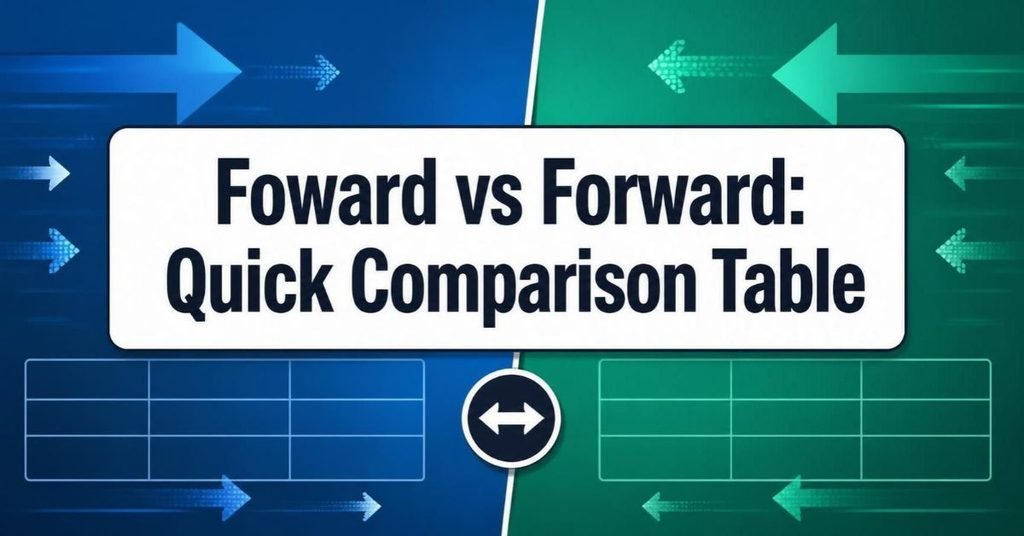
The main difference between Foward vs Forward is straightforward: forward is the standard spelling, while foward is a misspelling in ordinary English. The correct form includes two r letters.
| Feature | Forward | Foward |
| Standard spelling | Correct | Incorrect |
| Letter r | Two r letters | One r |
| Dictionary usage | Standard English word | Nonstandard misspelling |
| Meaning | Direction, progress, or sending onward | Usually intended to mean forward |
| Use in emails | Appropriate | Correct it before sending |
| Use in schoolwork | Recommended | Avoid |
How to Use Forward Correctly in a Sentence
The easiest way to understand forward word usage is to look at its role in a sentence. Forward can describe movement, modify a noun, or tell someone to send something onward.
Here are the main grammatical uses:
- Forward as an adverb: She stepped forward to answer the question.
- Forward as an adjective: The forward movement stopped suddenly.
- Forward as a verb: Please forward the email to the manager.
- Forward as a noun: The team’s forward scored the winning goal.
These examples show why forward grammar depends on context. The spelling stays the same even when the word performs different grammatical jobs.
You may also see forward in phrases such as move forward, go forward, press forward, and looking forward to the weekend. Each phrase has a slightly different purpose, but all use the same correct spelling.
Forward in American English and British English
The forward spelling in American English is the same as in British English. Writers in both varieties use forward, not foward, when referring to movement, progress, or sending information.
Some English words have different American and British spellings, such as color and colour. Forward isn’t one of those words. You don’t need to change its spelling for a British audience or an American one.
Real-Life Examples of Forward in Action
Examples make the correct spelling of forward easier to remember because they connect the word to familiar situations. Think about the messages you send, the plans you make, and the directions you give every day.
Here are several examples of forward in a sentence:
- Please forward the meeting details to the rest of the team.
- We need to move forward with the project this week.
- She took one step forward and introduced herself.
- I’m looking forward to the weekend.
- The car moved forward slowly.
- He leaned forward to hear the announcement.
- The coach asked the forward to stay near the goal.
Notice how the meaning changes with each sentence. In an email, forward means to send a message onward. In a discussion about plans, it often means making progress.
Correct Spelling in Business Emails
A forward email meaning is simple: you send an email you received to another person. Most email services use Forward as the label for this action.
For example, you might write, Please forward the invoice to the accounts team. Writing foward instead could make the message look rushed or poorly checked, particularly in professional communication.
If you’re unsure about the spelling, check the subject line, message body, and recipient details before sending. Small proofreading habits can make your business emails clearer without adding unnecessary effort.
Using Forward to Talk About Progress
The phrase move forward often means making progress after a delay, disagreement, or difficult experience. For example, a team might review a mistake and agree on how to move forward.
Similarly, press forward means to continue despite obstacles. Looking forward to something expresses anticipation, as in I’m looking forward to seeing you. These expressions are common in everyday English, so learning them helps you recognize the word naturally.
Common Mistakes People Make With Foward
The most obvious forward spelling mistake is leaving out the second r. Because foward looks similar to forward, your eyes may not catch the error when you’re reading quickly.
Another mistake is assuming that a familiar-looking spelling must be correct. People often type a word from memory without checking it, especially when writing on a phone. However, repeated exposure to an error doesn’t make it standard English.
Watch out for these common confusions:
- Foward vs Forward: Forward is correct; foward is a misspelling.
- Forword vs Forward: Forword is also incorrect when you mean forward.
- Forward vs Foreword: These are both real words with different meanings.
- Definately vs Definitely: Definitely is the correct spelling.
- Affect vs Effect: These words have different meanings and grammatical uses.
These common spelling errors are easier to avoid when you check the intended meaning instead of relying on how a word looks.
Why Do People Keep Typing Foward?
A common reason for this forward typing error is that people type quickly and leave out a letter. When a word feels familiar, your brain may recognize what you intended to write without noticing what you actually typed.
Phone keyboards can make the problem worse. Small keys, autocorrect suggestions, and hurried messages can all contribute to common typing mistakes in English. The missing r may go unnoticed until someone reads the message carefully.
Another reason is limited proofreading. If you regularly type forward without checking it, the same mistake may appear in emails, documents, and social media posts. A quick review before sending can catch the error.
How to Remember the Spelling of Forward
Try breaking the word into a simple visual pattern: for + ward. The standard spelling is forward, with the letter r appearing twice.
You can also connect the spelling to a familiar phrase, such as move forward. Write that phrase a few times, then use it in a sentence of your own. Repeating the correct form in context can make it easier to recall.
If you’re learning how to spell forward correctly, try these habits:
- Read the word slowly before submitting your work.
- Check a dictionary if you’re uncertain.
- Save a short list of words you often misspell.
- Use spell check, but don’t rely on it completely.
These small steps can help you avoid English spelling mistakes in school essays, work documents, and personal messages.
Which One Should You Use, Forward or Foward?
Use forward whenever you mean moving ahead, progressing, directing something onward, or sending a message to another person. It’s the correct spelling of forward in standard written English.
Avoid foward in essays, emails, reports, and published content. If you’ve already typed it, replace it with forward before submitting your work. This simple correction keeps your writing clear and follows standard English spelling conventions.
For example, write Please forward the report to Sarah, not Please foward the report to Sarah. The difference is only one letter, but the first sentence uses the accepted spelling.
| Also Read |
| Barrel or Barrell: Avoid This Common Spelling Mistake 2026 |
| Calf or Calve: What’s the Difference? (2026) |
| Really vs Realy: Meaning, Usage & Key Differences (2026) |
Forward vs Foreword: What’s the Difference?
Forward vs Foreword is a separate spelling comparison because both words are correct English words. Their meanings, however, are quite different.
Forward usually refers to direction, progress, or sending something onward. A foreword is a short introductory section at the beginning of a book, often written by someone other than the author.
Compare these examples:
- Please forward the document to my colleague.
- The author invited a historian to write the foreword.
The first sentence describes sending information. The second refers to an introduction to a book. Mixing them up can change the meaning of your sentence, so check which word fits the context.
Foward vs Forword: Which Spelling Is Correct?
Neither foward nor forword is the standard spelling when you mean moving ahead or sending something onward. The correct form is forward.
The confusion often comes from trying to spell the word by sound. However, English spelling doesn’t always match the way a word sounds, so checking a reliable dictionary is safer than guessing.
If you’re writing a sentence such as We will move forward with the plan, use forward. This spelling works in both American and British English.
Related Words People Often Mix Up
Foward vs Forward is one example of a broader problem with commonly misspelled English words. Many errors happen because people omit letters, rearrange them, or choose a spelling that looks familiar.
Here are some useful comparisons:
| Incorrect spelling | Correct spelling |
| Foward | Forward |
| Forword | Forward |
| Definately | Definitely |
| Recieve | Receive |
| Seperate | Separate |
| Writting | Writing |
| Tommorow | Tomorrow |
How to Check and Correct Forward Spelling Mistakes
Good proofreading and spell checking can prevent small spelling errors from reaching your readers. Start by reviewing your writing after finishing the first draft, especially if you’ve typed quickly or copied text between documents.
Spell checkers can identify many errors, but they don’t catch everything. If a misspelling resembles another recognized word or appears in a name, the software may not suggest the correction you need.
For reliable forward spelling correction, follow these steps:
- Read the sentence again and check its meaning.
- Look for the missing r in foward.
- Use a dictionary if you’re still unsure.
- Review the corrected sentence before submitting it.
These habits are useful for students, professionals, and anyone who wants to improve their written English.
FAQs About Foward vs Forward
Is foward ever correct in any dialect of English?
No, foward isn’t a standard spelling in American or British English. Use forward in formal writing, everyday messages, and professional communication.
What’s an easy trick to remember the correct spelling?
Remember forward has two r letters. Practice writing forward in sentences, such as Please forward the email, until the spelling feels familiar.
Does autocorrect always fix foward automatically?
No, autocorrect doesn’t always catch foward. Check your writing manually because keyboard settings, software, and context can affect spelling suggestions.
Final Thoughts
The Foward vs Forward question has a simple answer. Forward is the correct spelling, while foward is a common misspelling that leaves out one r. Use forward when describing movement, progress, or sending information to someone else.
Remember the correct spelling of forward whenever you’re writing emails, completing schoolwork, or publishing articles. If you type foward by mistake, correct it before sending your message. A quick spell check can save you from an avoidable error.
The main lesson from Foward vs Forward is easy to remember: forward is the standard form in both American and British English. Practice it in everyday sentences, and check a dictionary whenever you’re uncertain. Small improvements in spelling can make your writing clearer and more reliable.

Jack Thompson is the admin of ModernHexa.com, a platform focused on grammar, language, and effective communication. With a strong interest in English grammar and writing, Jack works to provide clear, practical, and easy-to-understand content that helps readers improve their language skills and communicate with greater confidence.
